
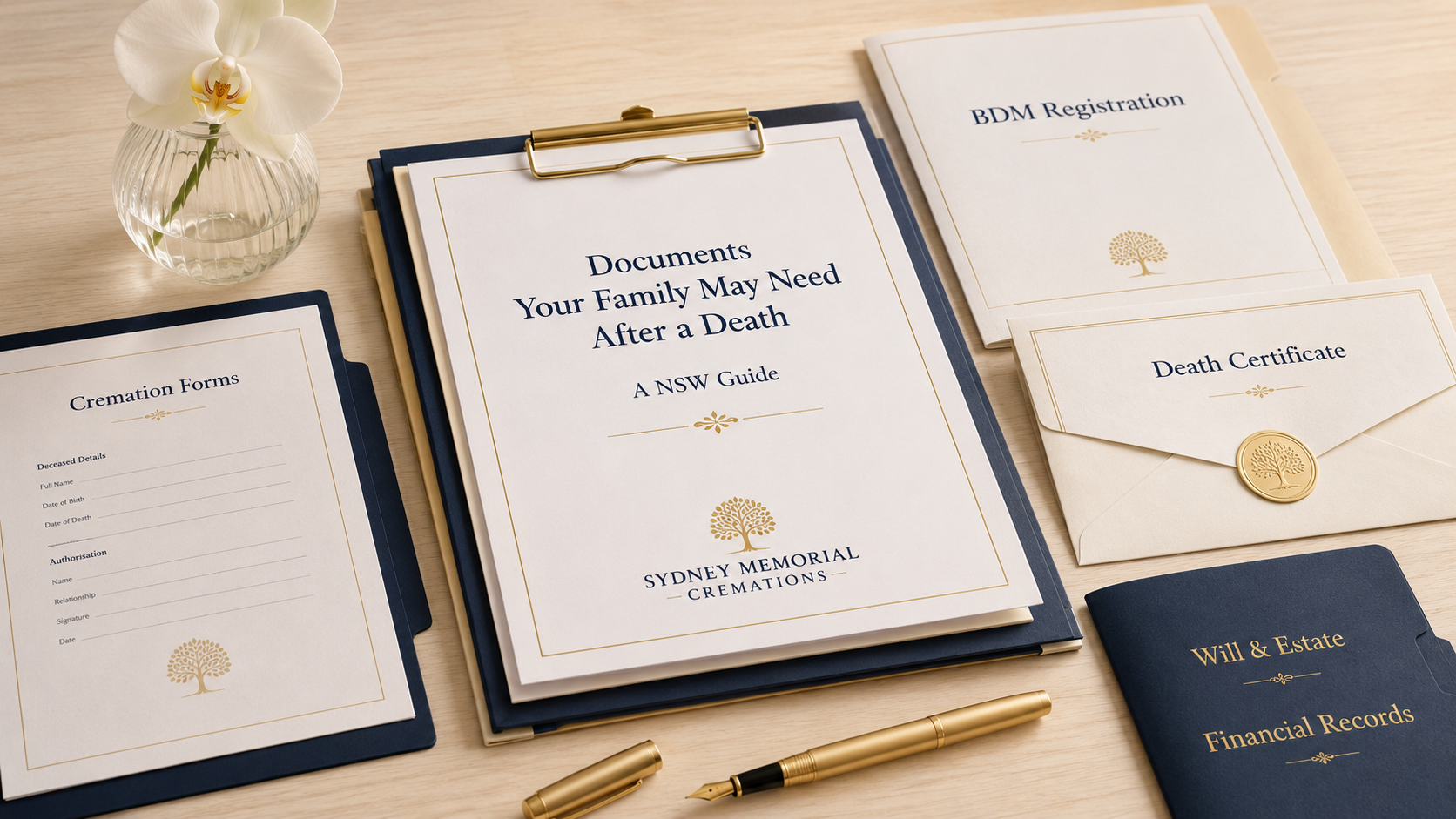
Navigating the paperwork after a loved one passes away can feel overwhelming. In New South Wales, the administrative process splits into two distinct chapters. First, your funeral director requires specific documents to legally proceed with the cremation and register the death. Second, your family or Executor will need several official documents to finalize the estate. Here is some information on the documents your family may need after a death.
At Sydney Memorial Cremations, we handle the heavy lifting of the initial paperwork for you. Understanding what documents are required—and what you will need later—can bring much-needed clarity to a difficult time.
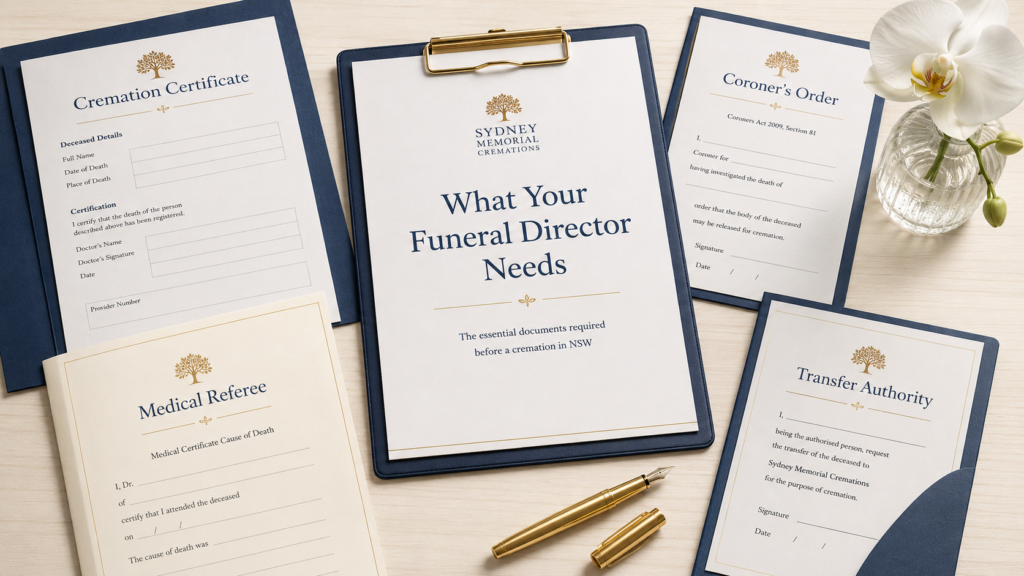
The forms we will need to complete on your behalf and information we will need
Part 1: Documents Needed Before the Cremation (NSW Law) That we chase up initially
New South Wales has strict legal safety checks before any cremation can take place. A funeral director cannot legally proceed without securing the following official medical and administrative forms:
-
Attending Practitioner’s Cremation Certificate: The primary treating hospital doctor or General Practitioner (GP) must issue this form to certify the medical cause of death. – This is sourced by your funeral director.
-
Medical Referees Cremation Certificate: Under NSW law, an independent, specially authorized doctor (a Medical Referee) must review the first certificate. They issue a second sign-off to double-check that there are no legal or medical reasons why the cremation cannot proceed. This is sourced by your funeral director.
-
Coroner’s Cremation Order: If the passing was sudden or unexpected and went to the Coroner, the Coroner issues this single order instead of the two doctor certificates listed above. This is sourced by your funeral director.
-
Transfer Authority & Application for Cremation: The Senior Next of Kin (SNOK) or Executor must sign this form, giving the funeral home legal permission to act. This form will be provided to you at the initial quote and the Senior next of kin will need to sign and send it back.
Part 2: Information Needed to Register the Death
Your funeral director must legally lodge the passing with the NSW Registry of Births, Deaths & Marriages (BDM) within one month of the death. To do this on your behalf, we will ask you for the following historical information about your loved one:
-
Full legal name, date of birth, and exact place of birth.
-
Details of any marriages (dates, locations, and full names of spouses).
-
Full names of children, along with their exact birth dates.
-
Parents’ full legal names (including mother’s maiden name) and their historical occupations.
-
If born overseas, the exact year they first arrived in Australia.
- You will also be asked if everyone is aware of the proposed cremation, the doctors name and address the deceased would regular see, whether the deceased had a pacemaker or if you require the coroners to examine them.
Part 3: Documents the Executor Will Need After the Funeral
Once the cremation service concludes, the responsibility shifts to the Executor of the Will or the Administrator of the estate. Financial institutions, government agencies, and utility providers will require specific official proof before they can release funds or close accounts.
The Executor will need to gather and present these vital documents:
1. The Certified NSW Death Certificate
This is the most critical document. Your funeral director applies for this formal certificate through Births, Deaths & Marriages when registering the death. It usually arrives a few weeks after the funeral. It can take NSW Registry 4-6 weeks sometimes to send you the death certificate. The death certificate will be sent to you via Registered post and you will need to provide your id to the post office to collect it. You will need certified copies of this certificate to close bank accounts, claim life insurance, and notify superannuation funds.
2. The Original Will
The Executor must locate the original, latest legal Will of the deceased. This document outlines who has the legal authority to distribute assets and manage the estate.
3. Grant of Probate (If Applicable)
If your loved one owned property or held significant funds in a bank account (usually over $20,000 to $50,000 depending on the bank), the Executor must apply for a Grant of Probate through the Supreme Court of NSW. This legal document confirms that the Will is valid and officially gives the Executor the right to distribute the assets.
4. Financial and Identity Documents
To finalize the estate, the Executor should also compile:
-
Recent Bank Statements: To identify active accounts, direct debits, and credit card balances.
-
Superannuation & Life Insurance Policies: To claim any outstanding death benefits or payouts.
-
Share Certificates or Property Deeds: To prove ownership of investments or real estate.
-
Tax Records: To lodge a final individual tax return with the Australian Taxation Office (ATO).
We Are by Your Side
Gathering these papers can feel like an administrative maze when you are grieving. Please remember you do not have to figure it out alone.
Natasha, Caroline, and our team guide Sydney families through this process every day. We ensure all pre-funeral certificates are handled flawlessly and seamlessly apply for your official BDM Death Certificate so your Executor can step forward with confidence. Reach out to us at any time if you have questions about the paperwork.